Home / Buying Guides / Mini amps and VU meter switchers under $150
Buying guide · updated 2026-10-08 · The Real Deal Meter team
Mini amps and VU meter switchers under $150 compared

Three boxes from Nobsound, and only one of them is an amplifier. The NS-04G PRO is a class D amp at about $30. The VU3 and VU3PRO are switch boxes with needle meters: they sit between amplifiers and speakers, route the sound and show it moving. Which one you need depends on what is already on your shelf, so this page starts there, then explains what “100W” and a swinging needle actually tell you.
| Product | Price | ||
|---|---|---|---|
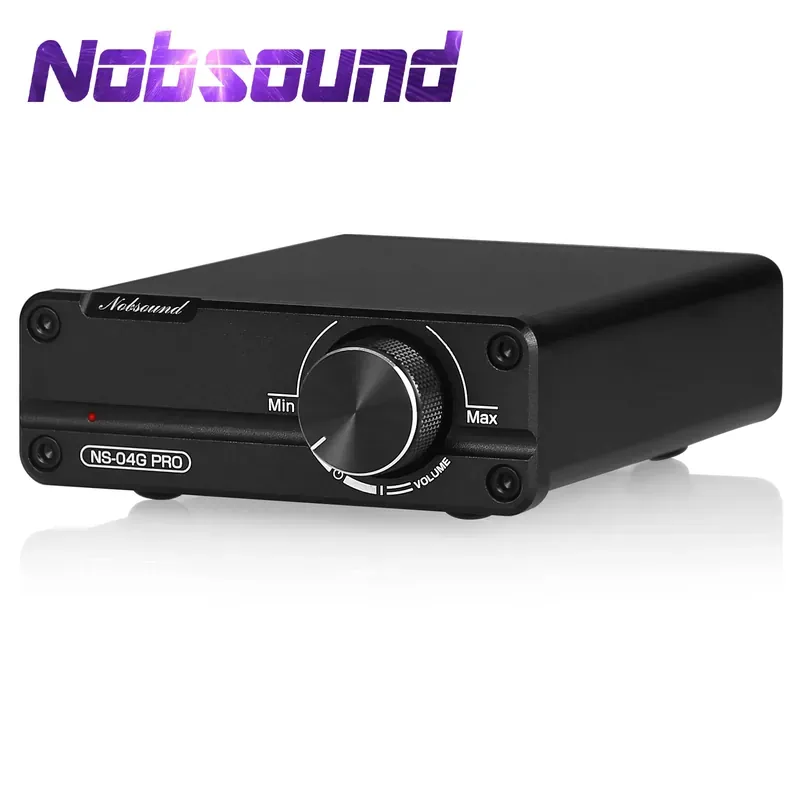
| The amplifier | Nobsound NS-04G PRO Mini Class D Amplifier (2x100W) Two TI TPA3116D2 class D chips, RCA in, speaker terminals out, for 4–8Ω passive speakers. The 100W per channel is Nobsound’s figure at 24V; TI rates this chip’s power at 10% distortion. 19 checks since Sep 20 · low $30.51 | ||
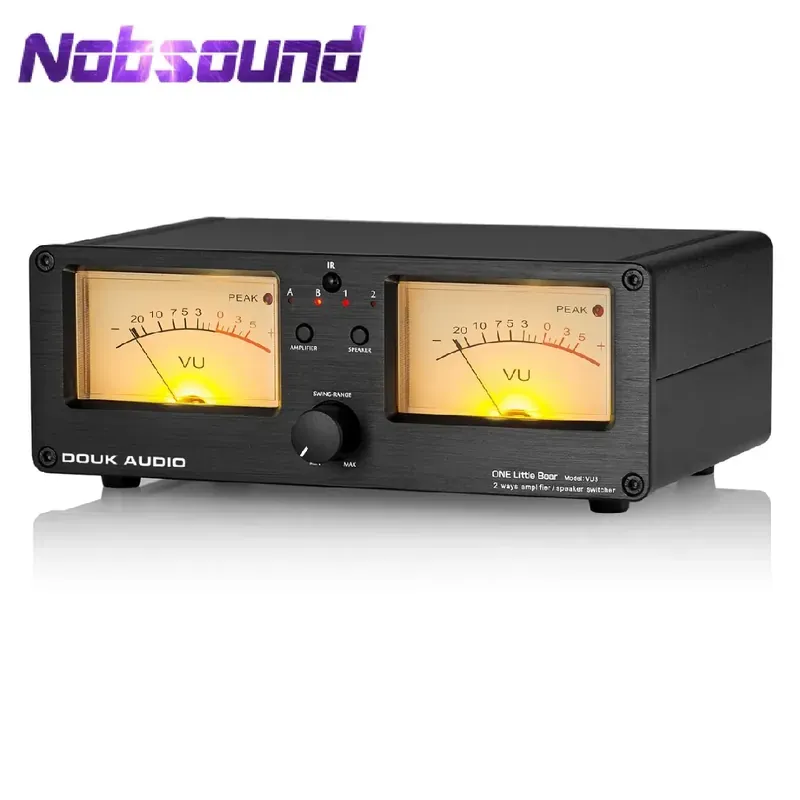
| A switch with meters | Nobsound Dual Analog VU Meter with 2-Way Amp/Speaker Switcher Sends one of two amplifiers to a pair of speakers, or one amp to one of two pairs, with backlit needle meters. Audio Science Review measured more distortion and mains hum with the VU3 in the path — arguably low in practice — and did not recommend it. 12 checks since Sep 20 · low $103.88 | ||
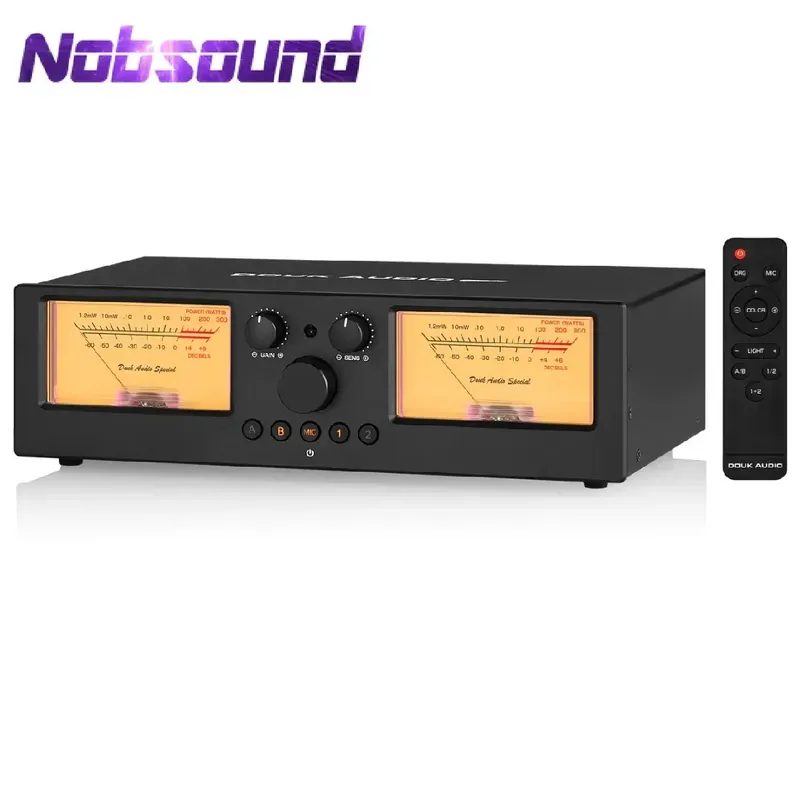
| Bigger meters, both pairs at once | Nobsound VU3PRO Amp/Speaker Switcher with VU Meters Two amps in, two pairs of speakers out, and both pairs can play together; larger meters and a 350W-per-channel pass-through rating. Douk does not say what load two pairs at once put on the amplifier, so with the NS-04G PRO (rated 4–8Ω) play one pair at a time unless Douk confirms otherwise. 13 checks since Sep 19 · low $132.90 |
Prices last checked 2026-10-08. Each one is re-checked daily and this table is rebuilt when any of them moves.
Paid links · We may earn a commission if you buy through them.One amplifier, two switch boxes: start with what you already own
The NS-04G PRO is an amplifier: sound in through RCA sockets, power out to speaker terminals, for passive speakers of 4 to 8 ohms 1. It is the only box on this page that makes anything louder.
The VU3 and VU3PRO are switchers. The VU3 sends one of two amplifiers to a pair of speakers, or one amplifier to one of two pairs 2; the VU3PRO takes two amplifiers in and can play both pairs of speakers at once 3. Both show the signal on needle meters.
So if you have speakers and nothing to drive them, you need the amp. If you have two amplifiers or two pairs of speakers and are tired of moving cables, a switcher is the tool. With one amp and one pair of speakers, a VU box is decoration — allowed, as long as that is what you are buying it for.
- Nobsound NS-04G PRO HiFi 2.0 Channel Digital Amplifier Mini Home Stereo Audio Amp 100W×2 Douk Audio — TPA3116D2 ×2; max output 100W+100W (4Ω load); RCA in, banana speaker jacks; 4-8Ω; DC 12V-24V; 19V supply optional; $46.99 without adapter, $56.99 with, on 2026-10-08
- Douk Audio VU3 Dual Analog VU Meter 2-way Amplifier/Speaker Audio Switcher Box Douk Audio — 2-in-1-out / 1-in-2-out; 300W per channel; built-in load resistors and no-load protection; supports BTL, class D and tube amps; $129.99 on 2026-10-08
- Douk Audio VU3PRO Amplifier/Speaker Selector VU Meter 2-in-2-out Switcher Box Douk Audio — 2-in-2-out, both speaker pairs can output at once; 350W@4Ω; isolated current sensor; load resistors to protect tube amps with no load; $154.99 (yellow, the only version available) on 2026-10-08
“100W” is a best case, not clean power
Nobsound sells the NS-04G PRO as 100W + 100W into 4 ohms 1, and its manual says that figure takes a 24V supply 2. The chips inside are two Texas Instruments TPA3116D2s 1. TI’s own data sheet rates that chip at 2 × 50W into 4 ohms at 21V, and the condition for that continuous-power rating is 10% total harmonic distortion plus noise 3.
The US rule for amplifier power claims asks for something stricter: continuous power per channel with all channels driven, at no more than 1% distortion, into 8 ohms 4. We found no independent measurement of the NS-04G PRO. The nearest is a measurement of an older Nobsound amp built on the same chip: on a 12V supply it reached 1% distortion at just over 12W into 4 ohms, and the reviewer called the 50W and 100W labels unrealistic 5.
That does not make it a bad amplifier. It makes 100W the wrong number to buy it on, and it makes the power supply part of the purchase: Nobsound rates the amp for 12 to 24V and lists a 19V supply as an option 1, its manual quotes power at 24V 2, and a higher-voltage supply raises the usable power 5.
- Nobsound NS-04G PRO HiFi 2.0 Channel Digital Amplifier Mini Home Stereo Audio Amp 100W×2 Douk Audio — TPA3116D2 ×2; max output 100W+100W (4Ω load); RCA in, banana speaker jacks; 4-8Ω; DC 12V-24V; 19V supply optional; $46.99 without adapter, $56.99 with, on 2026-10-08
- NS-04G / NS-04G PRO Stereo Digital Power Amplifier manual Douk Audio — “Powered by 24V power supply(4Ω load), the actual output power can reach 50W or 100W per channel”; default optional supply 19V
- TPA3116D2 data sheet (SLOS708G) Texas Instruments — 2 × 50 W into a 4-Ω BTL load at 21 V; continuous output power measured at THD+N = 10%, 1 kHz; 100 W into 2 Ω in mono
- 16 CFR Part 432: Power Output Claims for Amplifiers Utilized in Home Entertainment Products Federal Trade Commission (eCFR) — rated power: minimum continuous power per channel, all channels driven, at no more than 1.0% THD+N, into 8 ohms
- MEASUREMENTS: Yeeco TI TPA3116 Class D Amplifier (aka Nobsound NS-01G, Douk Audio F900S, Mogu F900S) Archimago's Musings — on a 12V supply, 1% THD+N at just over 12W into 4Ω; “unrealistic” to advertise as 50W × 2 or 100W; a higher-voltage supply increases usable power
A VU needle shows an average, not your amplifier’s power
A VU meter is a mechanical needle that averages the signal: it rises over about 300 milliseconds and cannot follow short peaks 1, so a sustained sound reads higher than a brief transient 2. That slow swing is what makes the needles pleasant to watch, and it is why they are not a power meter. Douk Audio’s page for its newer VU3-PLUS points the same way: after the VU3 PRO launched, buyers kept asking whether its meters could show real amplifier power, and Douk says that feedback “pushed us beyond visual metering” 3.
The meters are not invisible in the signal path, either. Audio Science Review ran a reference amplifier through the VU3 and found that the meters appear to load the source, with a sharp rise in second harmonic and mains hum; the reviewer allowed that the practical impact could be argued to be low, but did not recommend it 4. We found no measurement of the VU3PRO, which Douk says senses the signal with an isolated current sensor 5.
- VU meter Wikipedia — a mechanical meter that cannot show instantaneous peaks; 300 ms rise time
- Q. What's the difference between PPM and VU meters? Sound On Sound — an averaging voltmeter: a sustained sound reads significantly higher than a brief transient
- Douk Audio VU3-PLUS 2-way Amplifier/Speaker Selector with Accurate Power VU Meter Douk Audio — after the VU3 PRO launched, buyers kept asking whether its meters could show real amplifier power
- Douk VU3 Review (VU Meters) Audio Science Review — the meters load the source: a sharp rise in second harmonic and mains hum; SINAD still above 100 dB; not recommended
- Douk Audio VU3PRO Amplifier/Speaker Selector VU Meter 2-in-2-out Switcher Box Douk Audio — 2-in-2-out, both speaker pairs can output at once; 350W@4Ω; isolated current sensor; load resistors to protect tube amps with no load; $154.99 (yellow, the only version available) on 2026-10-08
Two amplifiers, one pair of speakers: the rules
Two amplifiers must never drive the same speakers at the same time; the voltages can damage the amplifiers 1. A switch box is how you avoid it: select one amplifier at a time. Amplifiers also dislike running with nothing connected — some shut down 1, and many valve amplifiers do not tolerate an open output 2 — and both Douk boxes have built-in load resistors for that reason 3 4.
One wiring catch matters for the NS-04G PRO. Its TI chip drives speakers through a bridged (BTL) output 5, and a simple A-B box that joins the amplifiers’ speaker grounds must never be used with BTL amplifiers 2. Douk says the VU3 supports BTL and class D amplifiers 3, but neither page explains how the negative lead is switched, so connect it exactly as Douk’s manual shows.
- Question of the Month: Connecting Two Amps to the Same Speakers Axiom Audio — the voltages would likely damage the amplifiers; amplifiers don't like running with no load and may shut down
- A-B Switch Box For Amplifier Comparisons Elliott Sound Products — never use that switch box with bridge-tied-load (BTL) amplifiers; many valve amps don't like an open-circuit output
- Douk Audio VU3 Dual Analog VU Meter 2-way Amplifier/Speaker Audio Switcher Box Douk Audio — 2-in-1-out / 1-in-2-out; 300W per channel; built-in load resistors and no-load protection; supports BTL, class D and tube amps; $129.99 on 2026-10-08
- Douk Audio VU3PRO Amplifier/Speaker Selector VU Meter 2-in-2-out Switcher Box Douk Audio — 2-in-2-out, both speaker pairs can output at once; 350W@4Ω; isolated current sensor; load resistors to protect tube amps with no load; $154.99 (yellow, the only version available) on 2026-10-08
- TPA3116D2 data sheet (SLOS708G) Texas Instruments — 2 × 50 W into a 4-Ω BTL load at 21 V; continuous output power measured at THD+N = 10%, 1 kHz; 100 W into 2 Ω in mono
What these prices mean
Each price here is the one we last read on AliExpress, and each product page shows the date and our full record. The NS-04G PRO was $34.32 when we first checked it on September 20, fell to $30.64 the next day and has stayed between $30.51 and $30.64 since; it was $30.59 on October 8. That day Douk Audio’s own store asked $46.99 for it without a power supply and $56.99 with one 1, so check which option the listing’s price is for.
The VU3 has stayed between $103.88 and $107.62 since September 20, and the VU3PRO between $132.90 and $137.69 since September 19. On October 8 Douk’s own store asked $129.99 for the VU3 2 and $154.99 for the VU3PRO with yellow meters, the only version it had 3. The struck-through “was” prices on these three listings, from $101.97 to $443.57, are the sellers’; we have not seen any of them charged. AliExpress reprices in dollars every day, so moves of a few cents are usually the exchange rate, and its “Welcome deal” prices and store coupons can take a listing below what is shown here.
- Nobsound NS-04G PRO HiFi 2.0 Channel Digital Amplifier Mini Home Stereo Audio Amp 100W×2 Douk Audio — TPA3116D2 ×2; max output 100W+100W (4Ω load); RCA in, banana speaker jacks; 4-8Ω; DC 12V-24V; 19V supply optional; $46.99 without adapter, $56.99 with, on 2026-10-08
- Douk Audio VU3 Dual Analog VU Meter 2-way Amplifier/Speaker Audio Switcher Box Douk Audio — 2-in-1-out / 1-in-2-out; 300W per channel; built-in load resistors and no-load protection; supports BTL, class D and tube amps; $129.99 on 2026-10-08
- Douk Audio VU3PRO Amplifier/Speaker Selector VU Meter 2-in-2-out Switcher Box Douk Audio — 2-in-2-out, both speaker pairs can output at once; 350W@4Ω; isolated current sensor; load resistors to protect tube amps with no load; $154.99 (yellow, the only version available) on 2026-10-08
Prices are what we last checked on each product's own page — follow a link for the current price and the date it was verified. Every outbound link here is an affiliate link; see Disclosure.
More buying guides → See every checked deal →© 2026 Real Deal Meter · Quote us with a link back · Copyright & reuse